






Free
Advanced risk management
What you'll learn
By the end of this section, students will:
Apply advanced position sizing models (fixed fractional, Kelly criterion, volatility-based sizing).
Understand portfolio-level risk and how to manage correlations between assets.
Learn dynamic stop-loss and trailing stop strategies to protect profits.
Master risk-to-reward optimisation for higher probability trades.
Build a personal risk management plan that aligns with trading goals and psychology.
Free
Advanced Trading Strategies
What you'll learn
By the end of this section, students will:
Explore multi-timeframe strategy integration for higher accuracy.
Apply volatility and momentum-based trading approaches.
Build confluence strategies using a mix of indicators, chart patterns, and price action.
Understand how to design rule-based systems for discipline and repeatability.
Learn to test, refine, and adapt strategies to different market conditions.
Free
Introduction to financial markets
What you'll learn
By the end of this section, students will:
Understand the structure and purpose of the major financial markets (forex, stocks, commodities, bonds, and derivatives).
Learn about the key participants — from retail traders to central banks and institutional investors.
Recognize how supply, demand, and economic events drive price movements.
Gain an introduction to market regulation and fairness.
Build the essential foundation for studying trading strategies and risk management.
Free
Strategies And Risk
What you'll learn
By the end of this section, students will:
Understand the importance of combining strategies with risk management.
Learn how to evaluate strategies using risk-to-reward ratios and win rates.
Explore how position sizing and stop-loss placement protect capital.
Recognize the psychological role of risk control in maintaining discipline.
Build the foundation for designing strategies that are realistic and sustainable.
Free
Mastering CFDs
What you'll learn
By the end of this section, students will:
Understand the structure and mechanics of CFDs.
Learn how to trade CFDs across multiple asset classes (forex, stocks, indices, commodities).
Apply leverage and margin effectively while avoiding overexposure.
Recognize the advantages and risks unique to CFD trading.
Integrate CFDs into a structured trading strategy with sound risk controls.
Free
Fundamental Analysis
What you'll learn
By the end of this section, students will:
Understand the purpose of fundamental analysis and how it differs from technical analysis.
Learn how economic indicators (GDP, inflation, employment, interest rates) affect markets.
Explore how company earnings, balance sheets, and ratios are used in stock analysis.
Recognize the role of geopolitics and global events in shaping market sentiment.
Combine fundamentals with other tools to create a more complete trading picture.
Free
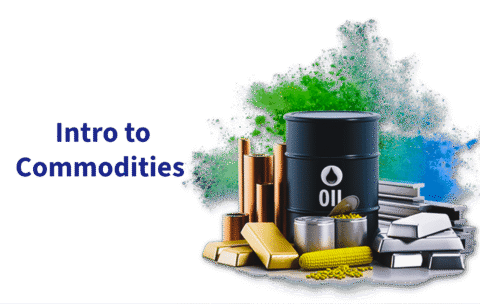
Introduction to Commodities
What you'll learn
In the Commodities Course, you will learn how global supply and demand, geopolitical tensions, and seasonal factors influence the prices of raw materials like oil, gold, silver, and agricultural products. The course will guide you through how to analyze commodity markets, understand price drivers, and use trading strategies such as futures and options. You’ll also gain insights into how commodities can be used for portfolio diversification, inflation hedging, and risk management, making them a vital component of capital markets trading.
